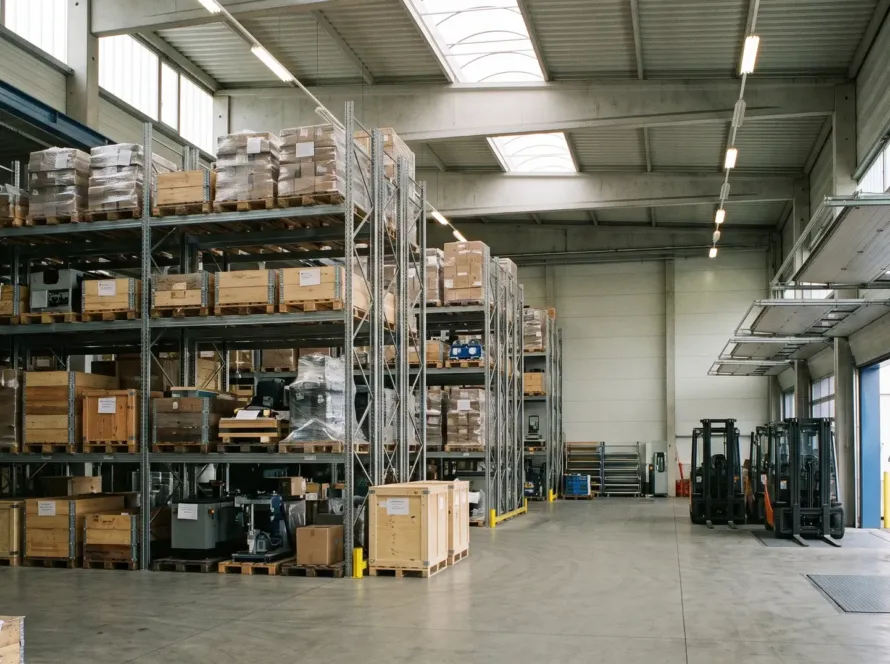
Logistics Bottlenecks in Ottawa: Labour, Equipment, and Flexible Warehousing
Logistics bottlenecks in Ottawa warehouses usually don’t start with a lack of space. They begin when stored materials can’t move efficiently through the facility due to limitations in labour, equipment, or operational flexibility.
Most businesses plan for storage capacity first. Fewer plan for what happens after materials arrive. That’s actually where the delays start.
What causes logistics bottlenecks in warehousing operations?
A warehouse isn’t just a holding space. It’s an active environment where goods must be handled, repositioned, and staged continuously. When that flow breaks down, inventory stops moving smoothly, even if there is technically enough space available.
Securing warehouse space is often treated as the main milestone in logistics planning. In reality, it’s only the starting point.
Why warehouse space alone doesn’t prevent delays
Once materials arrive, they need to be offloaded, moved, and organized in a way that supports ongoing project timelines. If any part of that chain is weak, congestion builds quickly.
In many Ottawa-based construction and infrastructure projects, materials arrive in phases. This means the warehouse is constantly shifting between quiet periods and high-volume activity. Without the right structure in place, that variability becomes a source of inefficiency rather than flexibility.
Equipment limitations: where many bottlenecks actually begin
One of the most common operational constraints is equipment capacity. A facility may have enough square footage but still struggle to move materials and manage inventory efficiently.
When equipment is undersized or mismatched to the load, operations slow down immediately. Materials may require multiple handling steps instead of one, or in some cases, must be staged temporarily outside the main storage area.
Typical equipment gaps that create delays
- Insufficient lifting capacity for heavy materials,
- Lack of crane support for oversized loads,
- Inefficient staging due to limited handling range,
- Overreliance on standard forklifts for industrial cargo.
At Valley Logistics, our forklifts handle loads from 3,500 to 25,000 lbs. For lifts beyond forklift range, crane support from 12,000 lbs up to 200 ton is arranged through a partner who supplies the cranes. See how each lift is planned on our heavy material handling page.
Labour: the hidden constraint behind warehouse performance
Even with the right equipment, nothing moves without skilled operators.
Warehouse labour is often assumed to be interchangeable, but in practice, it’s highly specialized. Experienced forklift operators and material handlers directly affect speed, safety and efficiency.
Why warehouse labour becomes a bottleneck
- Hiring cycles are slow and competitive,
- Skilled operators require certification and experience,
- Training adds time before full productivity is achieved,
- Retaining staff during low-demand periods increases cost pressure.
- Staff layoffs start the long hiring and training cycle again when demand increases.
This creates a structural challenge: businesses either over-hire so they have coverage when peak periods occur, or under-resource and risk delays when activity increases.
The result is inconsistency, and inconsistency is one of the primary drivers of logistics bottlenecks.
Hourly warehouse labour avoids that trade-off. At Valley Logistics, labour is billed by the hour, separately from storage, so you pay for handling when material is received, moved or released to site, and not for idle staff between deliveries.
The flexibility gap: why fixed warehousing is inefficient
Beyond labour and equipment, the most overlooked issue in logistics planning is flexibility.
Traditional warehousing models often require long-term commitments, typically measured in years. That structure assumes stable demand, but most industries don’t operate that way.
Construction, infrastructure, and industrial supply chains experience fluctuating requirements driven by project timelines, seasonal demand, and procurement schedules.
What fixed warehousing creates
- Paying for unused space during slow periods
- Maintaining labour capacity regardless of workload
- Limited ability to respond to sudden demand changes
What flexible warehousing solves
- Storage that scales up or down with project needs
- Labour and equipment aligned to actual demand
- Reduced overhead during low-activity phases
This kind of flexible warehousing is often referred to as progressive warehousing or scalable storage. It’s not just about reducing cost. It is about maintaining operational responsiveness.
How to identify logistics bottlenecks before they damage operations
Most bottlenecks are predictable if you know where to look. They typically begin as small inefficiencies that gradually compound over time.
Common early indicators include:
- Delays in unloading or staging materials,
- Uneven workload distribution across teams,
- Temporary storage overflow during peak periods.
The key is not just identifying storage needs, but understanding whether your operation can maintain flow when conditions change.
How Valley Logistics reduces logistics bottlenecks in Ottawa
Valley Logistics is structured around solving the three core causes of logistics bottlenecks: equipment constraints, labour availability, and inflexible storage models.
Instead of separating storage from operational capability, the system integrates them. Materials are received, stored, repositioned and released to site by the same team at 1255 Humber Place, with the handling equipment on site.
Key warehousing capabilities include
- Flexible storage that scales with project demand,
- Forklifts for loads from 3,500 to 25,000 lbs,
- A 50,000 sq ft secured yard for material suited to outdoor storage,
- Crane support from 12,000 lbs up to 200 ton, arranged through a partner,
- Hourly labour, billed separately from storage,
- Registered under the Controlled Goods Program, with 24/7 CCTV.
This structure is particularly relevant for construction, infrastructure, defence, and government projects where timelines and material volumes are not fixed.
Find progressive warehousing in Ottawa
If your operation involves heavy materials, phased delivery schedules, or fluctuating storage requirements, your bottleneck may not just be space. It may be flexibility.
Reach out to us about scalable warehousing solutions designed to align with your real project demands in Ottawa.